Tuesday, September 4, 2012

I Have Regenerative Braking
Some help from AEVA members and regen. braking is now working (emoticon with red face). The Vogue is still on axle stands but a quick test this morning showed power going back into the batteries and the rear wheels coming to a pretty quick stop when I lifted my foot off the accelerator pedal - no thump either. I had to allow torque to go negative for regen. I went to a lot of trouble to NOT let that happen - picturing a ride on lawnmover with forward/reverse control on the one pedal.
I have kind of come to the conclusion that the differential probably has no oil in it. I don't mean low - I mean none. The car sat in the back yard for about 6 years, then 3 years getting restored and electrofied - and I know the diff leaks, and not just the seals, I think it leaks out a faulty seal in the drain plug as well....
The rumble of gears running in a hollow diff housing is unmistakable (this only became obvious when running the car in the garage on axle stands). Fortunately I haven't driven the car very far in the last decade - since I checked the diff oil. I won't be running it again until I fill it. I have to pull the rear axles at some stage in the next year so I won't go overboard at this stage - I'll just fill it.
I have kind of come to the conclusion that the differential probably has no oil in it. I don't mean low - I mean none. The car sat in the back yard for about 6 years, then 3 years getting restored and electrofied - and I know the diff leaks, and not just the seals, I think it leaks out a faulty seal in the drain plug as well....
The rumble of gears running in a hollow diff housing is unmistakable (this only became obvious when running the car in the garage on axle stands). Fortunately I haven't driven the car very far in the last decade - since I checked the diff oil. I won't be running it again until I fill it. I have to pull the rear axles at some stage in the next year so I won't go overboard at this stage - I'll just fill it.
Wednesday, August 29, 2012
Door Liners ready for fabric
I finished punching out the holes in the door liners and we laid one of the front and one of the rear door liners out to see how we would cover them. The rag stealer was nosing around.

Here is one without the black silhouette in the way.

The orginal liners were covered in red vinyl with vulcanizing in several strips under the armrest area.

We decided to do two or three strips of silver starting where the vulcanizing starts at the bottom but not going quite to the armrest (the two smaller holes through the vulcanized area). When we laid fabric on the liner it was apparent that, even though the fabric has a foam backing, that the backing was not thick enough - it felt cheap. I'll buy some 3mm foam backing to go behind the fabric.
At some point in the past two weeks I made the decision to use the constant current balancers on all the battery packs in the car, not just the ones that showed errors on the drive - I just didn't mention it here. I have been moving the balancer chargers from pack to pack as each pack got to 59 VDC (3.69 x 16). Every pack has taken more than two days to reach internal cell balance - thats about 9AH (for a 20AH cell pair). The packs were certainly not correctly charged. The last two battery packs are on the 180mA constant current balancer chargers now - nearly there!

Here is one without the black silhouette in the way.

The orginal liners were covered in red vinyl with vulcanizing in several strips under the armrest area.

We decided to do two or three strips of silver starting where the vulcanizing starts at the bottom but not going quite to the armrest (the two smaller holes through the vulcanized area). When we laid fabric on the liner it was apparent that, even though the fabric has a foam backing, that the backing was not thick enough - it felt cheap. I'll buy some 3mm foam backing to go behind the fabric.
At some point in the past two weeks I made the decision to use the constant current balancers on all the battery packs in the car, not just the ones that showed errors on the drive - I just didn't mention it here. I have been moving the balancer chargers from pack to pack as each pack got to 59 VDC (3.69 x 16). Every pack has taken more than two days to reach internal cell balance - thats about 9AH (for a 20AH cell pair). The packs were certainly not correctly charged. The last two battery packs are on the 180mA constant current balancer chargers now - nearly there!
Monday, August 27, 2012
New Door Liners
While I waited for the last 3 battery packs to balance I busied myself making the door liners. The old masonite door liners on the Vogue were water damaged (why do people insist on removing the plastic sheets between the door liners and the door panels and not putting them back), so it is necessay to make new ones.
This one is typical of the old door liners.

I have elected to use 3 ply as it is reasonably light and better when it comes to water damage (I'll be using plastic sheet under it as well).
First I acertained that the door liners on left and right sides of the car were mirror images of one another. Then I choose the best one, stripped off the vinyl and traced it onto my 3 ply - including the holes for handles, window winders, armrests and mounting clips. Then I firmly applied masking tape over the lines where I was going to use my old trusty jigsaw.

Once cut, removing the masking tape shows hardly any splintering.

I am lucky enough to have inherited (really) some hole punches. The door clips and armrests use a 1/2" hole. The only problem I had was on one panel near the corner it split the whole corner out. Some woodglue fixed that.

I had to bash out over 100 holes.
I now have four stamped 3 ply panels. Next comes a test fit (just to be sure the armrest, winder and door opener holes are correct) then the fabric covering.
This one is typical of the old door liners.

I have elected to use 3 ply as it is reasonably light and better when it comes to water damage (I'll be using plastic sheet under it as well).
First I acertained that the door liners on left and right sides of the car were mirror images of one another. Then I choose the best one, stripped off the vinyl and traced it onto my 3 ply - including the holes for handles, window winders, armrests and mounting clips. Then I firmly applied masking tape over the lines where I was going to use my old trusty jigsaw.

Once cut, removing the masking tape shows hardly any splintering.

I am lucky enough to have inherited (really) some hole punches. The door clips and armrests use a 1/2" hole. The only problem I had was on one panel near the corner it split the whole corner out. Some woodglue fixed that.

I had to bash out over 100 holes.
I now have four stamped 3 ply panels. Next comes a test fit (just to be sure the armrest, winder and door opener holes are correct) then the fabric covering.
Friday, August 24, 2012
Pack #9 Update (balancing the battery packs)
There's those who say that you can't tell a LiFePO4 cell's State Of Charge (SOC) from the cell voltage.
They're right!
In my previous post I mentioned that cells around 3.3V appeared to only be about 2 to 4AH shy of fully charged.
Well in Pack #9, we have so far put 11AH into a cell that initially measured at 3.28V and it's only just up to 3.5V - so it's nearly charged. The critical voltage at 20 degrees C for reasonably new LiFePO4 Headway cells seems to be between 3.2 and 3.4 V.
I had ideas of logging pack voltage and current and coming up with a SOC indicator that didn't have to measure AH in and out of the pack. The idea was to compensate the pack voltage with the current being drawn from it and assume a particular SOC from the compensated voltage. I think it may be harder than that!
William is at home today and I'm at work, so I am getting cell voltage and current updates from him.
They're right!
In my previous post I mentioned that cells around 3.3V appeared to only be about 2 to 4AH shy of fully charged.
Well in Pack #9, we have so far put 11AH into a cell that initially measured at 3.28V and it's only just up to 3.5V - so it's nearly charged. The critical voltage at 20 degrees C for reasonably new LiFePO4 Headway cells seems to be between 3.2 and 3.4 V.
I had ideas of logging pack voltage and current and coming up with a SOC indicator that didn't have to measure AH in and out of the pack. The idea was to compensate the pack voltage with the current being drawn from it and assume a particular SOC from the compensated voltage. I think it may be harder than that!
William is at home today and I'm at work, so I am getting cell voltage and current updates from him.
Thursday, August 23, 2012
Battery Pack Balancing Update
The pack balancing is going well, albeit slowly. I have two 180mA current source chargers running all the time balancing the cells in packs that didn't show alerts during the drive. I move them to the next pack when the pack under charge gets to 59 VDC (3.69 * 16). As well as that, I am pulling each of the 5 alerting packs (minus one that was too difficult to remove and responded to 3.5 days of 180mA charging) out of the car, lifting the lid, and charging the low cells with an Individual Cell Charger (ICC).
The ICC is a small PC power supply that has an adjustable 5V, 5A output. It doesn't adjust all the way down to 3.7V so I have two 3A diodes in series and have it set to 5.2VDC. The diodes drop 1.6V at 3A and 1.5V at 180mA so it's reasonably safe to leave unattended. When I pull a pack from the car, I start by measuring all cell pairs then use the ICC on the low cells. I generally find that there are about 12 cell pairs over 3.6V and 4 at 3.3 to 3.4. The 3.3V seem to need about 4 AH put into them. Cells that have been 3.2V have needed up to 17AH. Considering the cell pairs are 20AH, that's pretty discharged.
So far all but one of the packs (the one that had a cell that took 17AH) I have pulled out have had the 180mA treatment before I decided to remove them, but pack #9 which get removed from the car tonight has only had the post-drive charge to 58.4V, (the 3A charger cut back after only an hour) so it will be interesting to see the SOC of the cells.
I only have one of the alerting packs left to pull out of the car, pack #9.
The ICC is a small PC power supply that has an adjustable 5V, 5A output. It doesn't adjust all the way down to 3.7V so I have two 3A diodes in series and have it set to 5.2VDC. The diodes drop 1.6V at 3A and 1.5V at 180mA so it's reasonably safe to leave unattended. When I pull a pack from the car, I start by measuring all cell pairs then use the ICC on the low cells. I generally find that there are about 12 cell pairs over 3.6V and 4 at 3.3 to 3.4. The 3.3V seem to need about 4 AH put into them. Cells that have been 3.2V have needed up to 17AH. Considering the cell pairs are 20AH, that's pretty discharged.
So far all but one of the packs (the one that had a cell that took 17AH) I have pulled out have had the 180mA treatment before I decided to remove them, but pack #9 which get removed from the car tonight has only had the post-drive charge to 58.4V, (the 3A charger cut back after only an hour) so it will be interesting to see the SOC of the cells.
I only have one of the alerting packs left to pull out of the car, pack #9.
Monday, August 20, 2012
Battery Balancing and Steering column cowl
It's been a bit of a slow week with one battery pack opened up for individual cell balancing and others with a 0.01 C controversial balancing charge.
Pack opened for examination and individual cell charging.

I have also been experimenting with finishes for the steering wheel centre and steering cowl. I tried a leather dye but it would not soak in, then vinyl paint which peeled off in a very strange way. I have fallen back to prime and paint.
Primed.
 The top of the cowl.

Pack opened for examination and individual cell charging.

I have also been experimenting with finishes for the steering wheel centre and steering cowl. I tried a leather dye but it would not soak in, then vinyl paint which peeled off in a very strange way. I have fallen back to prime and paint.
Primed.


Thursday, August 16, 2012
More Video of Second Drive
Another short video. This is where we stopped at lights to turn right, then upon moving away, the battery alert started.
Balancing my Battery Packs
I posted some thoughts on the AEVA forum so I could get some feedback from like-minded souls about my battery pack issues. It may be of interest to some who read this blog so here is the link. It's about the eighth post on the page.
http://forums.aeva.asn.au/forums/forum_posts.asp?TID=2707
http://forums.aeva.asn.au/forums/forum_posts.asp?TID=2707
Tuesday, August 14, 2012
Some notes on the Second drive
The drive on Sunday showed up some minor problems.
The thump happens when the accelerator transitions through the point where I am requesting full speed (variable torque), to the point where I am requesting zero speed - at about 10% pedal depression.
I left a 100mS ramp up/ramp down in the speed section of the controller, thinking it did not effect torque control - but it may.
If that doesn't help, the easy fix is to implement a ramp function on the Analog input (a function block in the controller), and limit the ramp down speed to that which doesn't cause the thump - but I'd rather identify and take the correct action. I'll put it up on axle stands and have a fiddle.
2.
Weird. I will connect the laptop and monitor the internal controller signals and trace through while on the axle stands. This is pretty easy to do as the Lenze software lets you tap into any analog or digital code of function block output and display as a dial or digtal readout or both. Up to 8 at once.
3.
Seven packs were at 52.5V and 5 (with LEDs off) were below 51 V. After a full charge, I pulled the lowest voltage one (as measured after the fault event) from the car and have so far put 12AH into one of the 20AH cell pairs. There were 4 cells pairs under 3.25V - the rest were 3.6V or higher - keep in mind this pack just got fully charged!
They are obviously way out of balance. To use an Americanism - "my bad". I thought since all chargers had cut out and all packs were at 58V they were balanced - not at all! The remaining 11 packs are on charge for the 4 days it will take for 180mA to charge all cells. It took me a whole night just to charge one cell pair in one pack so that's not reasonable to do for the 5 packs. I will change the the pack I have out to the same "trickle" or CV charge and monitor it closely to ensure I'm kind of OK. I don't like doing this but it's untenable to pull every pack.
- There was a "thump" from the driveline when I eased up on the accelerator too fast - even as very slow speeds. This was easy to avoid but it's a bug nevertheless.
- Regen braking didn't work at all. Pretty clever for me to muck up something that is hard to prevent.
- We only travelled about 5km before I got a battery low alert. Upon returning home, 5 out of the 12 packs were showing a low voltage event (blue LED off).
The thump happens when the accelerator transitions through the point where I am requesting full speed (variable torque), to the point where I am requesting zero speed - at about 10% pedal depression.
I left a 100mS ramp up/ramp down in the speed section of the controller, thinking it did not effect torque control - but it may.
If that doesn't help, the easy fix is to implement a ramp function on the Analog input (a function block in the controller), and limit the ramp down speed to that which doesn't cause the thump - but I'd rather identify and take the correct action. I'll put it up on axle stands and have a fiddle.
2.
Weird. I will connect the laptop and monitor the internal controller signals and trace through while on the axle stands. This is pretty easy to do as the Lenze software lets you tap into any analog or digital code of function block output and display as a dial or digtal readout or both. Up to 8 at once.
3.
Seven packs were at 52.5V and 5 (with LEDs off) were below 51 V. After a full charge, I pulled the lowest voltage one (as measured after the fault event) from the car and have so far put 12AH into one of the 20AH cell pairs. There were 4 cells pairs under 3.25V - the rest were 3.6V or higher - keep in mind this pack just got fully charged!
They are obviously way out of balance. To use an Americanism - "my bad". I thought since all chargers had cut out and all packs were at 58V they were balanced - not at all! The remaining 11 packs are on charge for the 4 days it will take for 180mA to charge all cells. It took me a whole night just to charge one cell pair in one pack so that's not reasonable to do for the 5 packs. I will change the the pack I have out to the same "trickle" or CV charge and monitor it closely to ensure I'm kind of OK. I don't like doing this but it's untenable to pull every pack.
Second Drive (first major drive)
On Sunday afternoon I was finally ready for Laurel and I to get in the
Vogue and see how it went at more than 16 km/h (first drive). There is a
lot to tell here, but I'll start with two of the uncut videos.
Then out the driveway.
We ended up with seven videos so I'll have to do some editing soon to put them together.
Saturday, August 11, 2012
Tailshaft (driveshaft) Instal
About the last thing to be done before the second test drive on Sunday was to instal the tailshaft. I messed around with the front M10 bolts for at least an hour, taking them out, putting them in, without success. I finally came to realise that, while they fitted the Uni yolk and turned OK, when they were started in the coupler thread, they would not go in - the peaks on the bolt heads did not clear the Uni yolk protusions.
I ended up using two M8 bolts to hold it in until I got some machine screws (Bunnings only had course thread).
During this process I had to come up with something the right height to hold the other end of the tailshaft roughly in position.

This did nicely -(product placement alert).

Yes, we drove on Sunday - more to come...
I ended up using two M8 bolts to hold it in until I got some machine screws (Bunnings only had course thread).
During this process I had to come up with something the right height to hold the other end of the tailshaft roughly in position.

This did nicely -(product placement alert).

Yes, we drove on Sunday - more to come...
Friday, August 10, 2012
Bonnet Latch Fitted
The bonnet now has the main latch and release fitted. Up until now I have only had the secondary or safety latch which has been making it easier to open and close the bonnet. If I'm planning on going faster then 16km/h (see first drive) I'll need it closed properly. I reconditioned it over a year ago. All went well - it was quite easy to align the pin with the latch
I have updated the to-do list post again. Refresh your browser (Windows F5) if you have already visted that post.
 The release and spring have been added to actual latch side.

I have updated the to-do list post again. Refresh your browser (Windows F5) if you have already visted that post.


Thursday, August 9, 2012
Internal Front Door Handles Installed
We can now get out of the car.
The list a couple of posts ago has been updated.
Refresh your browser (Windows F5) if you have already visted that post.
The list a couple of posts ago has been updated.
Refresh your browser (Windows F5) if you have already visted that post.
Wednesday, August 8, 2012
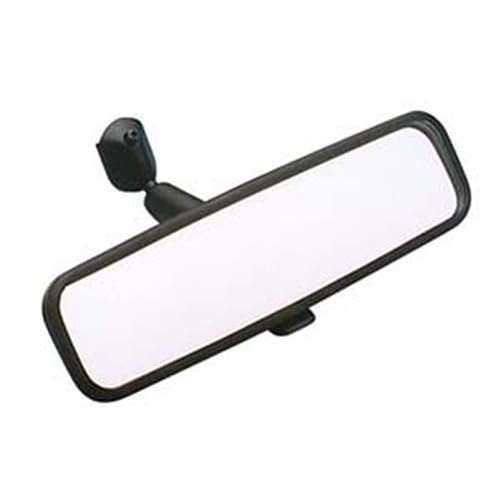
Rear View Mirror Mount Failed
Mounting the rear view mirror is back on the list.
I carefully scraped off the excess silicone last night and secured the mirror to the plastic mounting tab.
Then I squared myself up in the driver's seat and reached up and adjusted the mirror - and it came off in my hand. The silicone stuck to the glass just fine - but not to the plastic mount. It took a while to scrape the silicone off the windscreen - it was stuck very well! There was NO silicone stuck to the plastic mount. Keep in mind that the little tube of silicone (vinegar smelling type) came with the mounting kit.
I have read a fair bit (web) on these failures recently so my three choices are:
BTW - The silicone oozed out the sides of the mount - none of it went up those square holes in the mount which are obviously designed to "key" the glue.


I carefully scraped off the excess silicone last night and secured the mirror to the plastic mounting tab.
Then I squared myself up in the driver's seat and reached up and adjusted the mirror - and it came off in my hand. The silicone stuck to the glass just fine - but not to the plastic mount. It took a while to scrape the silicone off the windscreen - it was stuck very well! There was NO silicone stuck to the plastic mount. Keep in mind that the little tube of silicone (vinegar smelling type) came with the mounting kit.
I have read a fair bit (web) on these failures recently so my three choices are:
- Rough up the back of the plastic mounting tab with sandpaper and try the silicone again (I have enough left to try once more).
- Use the metal mounting tab that came with the mirror although I'm concerned that the silicone is the corrosive type.
- Go and get another adhesive product for mounting mirrors.
BTW - The silicone oozed out the sides of the mount - none of it went up those square holes in the mount which are obviously designed to "key" the glue.
Tuesday, August 7, 2012
Rear View Mirror and Current To-Do List
I stuck the fitting for the rear view mirror on the windsceen last night. I'm hoping Laurel won't make me take it off and do it again because I was a fraction too sparing with the silicone and it missed a tiny bit at the bottom of the fitting. That will teach me to ignore youtube advice that says to be sparing. It won't matter to the mirror staying on, but if you look closely from the outside you can see it.
This list waxes and wanes but this is the to-do list as it stands during August (I'm updating this list as each item gets done - press F5 with Windows to refresh your browser).
The priority column has an asterrisk for things I need to do to be able to do the next test drive - the 60-80kmh runs. From this point on they are all pretty trivial but the project plan shows one resource (me) and the tasks are all in series. (Lenze is the motor controller.)

Monday, August 6, 2012
Dashboard, Glovebox and Front Seats In!

On Saturday I figured out the wiring for the dash, added a new 4 way connector for the Forward/Reverse wires and installed the dashboard.
Of course, like everything with the Vogue, it wasn't that simple. First I had to mount the two side trims that hide the dashpad vinyl edge at the sides. The left hand side didn't fit so it took about half an hour of fiddling to come up with a reasonable comprimise. Then another half an hour to locate the fasteners that hold the dash in and I was ready.
Other than the fact that the Vogue wiring loom appears to have shrunk (why, why are looms always just too short?), it went in fairly easily. The glovebox door was next - about a two hour job but finally - it opens and shuts and matches the dash mounts pretty well. I may attack the bottom of the dashpad with a heat gun to see if I can stop the glovebox door scraping on it when it is opened - later.
Sorry about the poor quality of photos - I took them this morning with no electricity in the garage due to some switchboard work we are having done.

On Sunday I fired up the dashboard for the first time and was met with the first problem. When I turned the ignition on, but not started yet, the dash powered up OK but the peizo warning buzzer under the dash started to sound - quietly. The piezo is supposed to sound under two conditions. A warning from the controller - usually that a battery pack is under or over voltage - and a warning that you are trying to start the car while Forward or Reverse is selected. It took me a while to cotton on the the fact that the ignition switch was "leaky". It obviously has some resistance between Ignition contact and the Start contact - just enough to be a problem for my relatively high impedance circuit (peizo sounds with 10K in series from 12VDC).
A dashboard bulb to ground fixed it and so did a 1 watt 270 Ohm resistor - now added. This isn't the orginal Vogue ignition switch - the one that the key falls out of. This is one I had "under the house" and that I thought I'd cleaned out pretty well - obviously not. There is no current drawn (less than 70uA) from the 12V battery when the ignition is off so it shouldn't be a problem. I'll come back to it later anyway - next time I'll really flush it out and do some measurements while at it.
Sunday afternoon I finished off some minor trim hiccups that arose when installing the dash and installed the two front seats. We finished off the leather cover on the steering wheel and dropped that on to get it out of the house (the steering wheel, not the car) - it's not secured yet. Then I installed the washer/wiper switch and encountered my next Lucas electrical problem - no high speed wipers. My backup switch had no low speed either. These ones are totally sealed - I tried drilling though the side so I could flush it out but I didn't make it through the bakelite. I'll try to find a new one - with an electric switch for the pump instead of a manual pump. For now, single speed wipers are fine
Another view of the dash, seats and carpet.
There was a plan to drive the car Sunday afternoon but with everything taking longer than expected I didn't install the indicator arm, rear view mirror, driveshaft, or put the final configuration in the controller so it wasn't going to happen. Just as well because it rained from about 2PM onwards and I don't want water on it just yet. (I have to seal the windscreen corners before it gets wet or dirty).
 I
IThursday, August 2, 2012
Dashboard Mounts
Try as I might I could not figure out which way the 'L' brackets at the bottom of the dashboard went on. I certainly did not take enough pictures when dis-assembling the dash. Fortunately I have a complete, albeit rather sad but intact, spare under the house. So I crawled under the house last night (at 8 degrees C) and took this picture. Other than that, the only work on the car last night was to glue the vinyl bottom into the glovebox and secure the clips that will hold it in place. Oh - I also soldered a bullet connector to a wire so I can intercept the reversing lights wire before installing the glovebox.
I had a bit of homework to do so nothing more on the car last night.
The spare dash with mounting brackets circled. Note the spare diff/axle casing and diff underneath. I wondered where those aluminium stabilisers (spelt wrong on sticker) got to...

We were discussing a few nights back how, if we ever moved house, I couldn't survive on a concrete block - no under the house storage.
I had a bit of homework to do so nothing more on the car last night.
The spare dash with mounting brackets circled. Note the spare diff/axle casing and diff underneath. I wondered where those aluminium stabilisers (spelt wrong on sticker) got to...

We were discussing a few nights back how, if we ever moved house, I couldn't survive on a concrete block - no under the house storage.
Tuesday, July 31, 2012
Hi to Humber UK - Glovebox
My stats tell me that the Humber UK forum has discovered the Electric Vogue blog. Hi guys. You are welcome to leave comments (just be nice).
I painted out the inside of the glovebox liner last night ready to put a new vinyl bottom in it. I have used this Bristol vinyl paint for a few things now - great stuff!

I also installed the glovebox door's handle and lock and I'm trying to figure out what screws go where to hold the dashboard in the car.
I have to clip the rag stealer (poodle) tonight so not much will get done. We are pretty much on track to do the major test drive on Friday (if I take the day off which is on the cards).
I painted out the inside of the glovebox liner last night ready to put a new vinyl bottom in it. I have used this Bristol vinyl paint for a few things now - great stuff!

I also installed the glovebox door's handle and lock and I'm trying to figure out what screws go where to hold the dashboard in the car.
I have to clip the rag stealer (poodle) tonight so not much will get done. We are pretty much on track to do the major test drive on Friday (if I take the day off which is on the cards).
Monday, July 30, 2012
Removing Contact Adhesive from Fabric
A few times throughout the Vogue restoration I have accidently smudged the fabric of seats or trim with contact adhesive and gone into a blind panic. Firstly, with vinyl, just wait until it's not runny (10 to 30 seconds) then rub it around for a little while with your fingers and it will ball and come off - usually with no trace at all.
Fabric is another matter, but I found out early on that Lacquer Thinners works perfectly. It doesn't appear to harm the fabric - at least automotive velour. Just a small slurp on a clean rag and gently wipe it off in the direction of the pile - in fact any direction and finish off in the pile direction. At one stage I was using spray adhesive (3M High Tack) and got quite a lot on one of the seats - the overspray looks like thin string. The thinners took it all off with no trace. I have always done this while the adhesive was still wet though. I don't know about other types of thinners - just lacquer.
Fabric is another matter, but I found out early on that Lacquer Thinners works perfectly. It doesn't appear to harm the fabric - at least automotive velour. Just a small slurp on a clean rag and gently wipe it off in the direction of the pile - in fact any direction and finish off in the pile direction. At one stage I was using spray adhesive (3M High Tack) and got quite a lot on one of the seats - the overspray looks like thin string. The thinners took it all off with no trace. I have always done this while the adhesive was still wet though. I don't know about other types of thinners - just lacquer.
Pinchweld and Seatbelts Finished


The drivers side of the base of the rear seat showing the interface with vinyl and carpet.

The front seatbelts turned out to be a bit more difficult. I only had the shoulder bolts that came out of the car and these belts only had one rotating point - the other two were fixed and intended to be fixed securely in position (smaller hole) - not using shoulder bolts! My better judgement said not to use the wrong type of bolt - especially in a safety system, so a quick trip was made to Supercheap to buy some 7/16" high tensile bolts.
The front seatbelts in the Vogue get anchored at the rear two positions in the rear passenger footwell and are fairly obvious.

The decision then was whether to cut a slit in the carpet or punch a 22mm hole in the carpet (I just happen to have a 22mm punch) and mount the buckle above the carpet - we choose the latter (as you can see above). I figured that I'll have extra replacable carpet mats on top anyway. Complications started when the carpet would not sit correctly at the sides. I had to cut down two shoulder spacers to make regular spacers to get enough space for the whole thing to sit correctly. Somehow it took several hours.
LED interior light above seatbelt mount.

Lower section of pillar trim show interface with pinchweld, vinyl trim and sill guard.

Handbrake and cowl.

View of centre pillar trim showing colour change halfway down.

I was really hoping to drive it on Sunday but we haven't finished the leather cover on the steering wheel and I spent most of Sunday fiddling with the dashpad vinyl in order to be able to fit the dash. I did manage to get the glovebox metal molding into position - held with 1/8" countersunk bolts instead of those cursed pop rivets that I had to drill out.


Now for the door linings...
Tuesday, July 24, 2012
Rear Doors Pinchweld Installed.
I ran the pinchweld down the front edge of the rear door openings last night. It took just under 90 minutes. So the rear is finished except for putting the seatbelts and seats back in. I'm on target for seats going in this week.
Monday, July 23, 2012
Another Vogue Article
I found another great Vogue article. Among other things, this one explains why there was never a Mk3 Vogue Sports - they all were (the Mk3s that is)!
The Australian Humber Vogue
(Here is a Link to the previous Vogue article)
The Australian Humber Vogue
(Here is a Link to the previous Vogue article)
Interior Trimming - Pinchweld Installation
I finished and installed the centre pillar trim on Saturday.
I then spent an amazing amount of time trimming and gluing down bits that I hadn't noticed until I was ready to install the pinchweld (furflex/windlace). I bought the pinchweld from Basis in New Zealand.
This is the top part of the centre pillar trim showing the connector for the interior light and seat belt mounting hole. I hadn't glued it down at this point.

The lower part is in blue.

We changed fabric just level with the top part of the door linings (yet to be done). The top, grey fabric is the headlining fabric, the lower blue is the seat and door liner (yet to be done) fabric.

Having the pillar trim on allowed me to get on with installing the pinchweld - that's the stuff that clips around the body seams where the door closes. When we renewed the pinchweld on the Super Snipe we cut 45 degree angles on the right angle corners and I have never been that happy with the job. On one of the MGB forums someone had indicated that the correct way was to hammer the stuff into the corners and get as small a radius as possible - but it wouldn't be perfect. I cut of a piece and tried that and it wasn't very good. The metal parts of the pinchweld poked out through the fabric.
A note here that the cheaper plastic pinchweld is a LOT easier to install as it is quite easy to cut at 45 degrees. The "furflex" style that I have used is a metal spine with automotive fabric wrapping as you will see in the pictures.
So the technique I settled on was to unpeel the fabric partly, cut the metal at a right angle, then re-seat the fabric and cut a 45 degree angle in just the fabric. The result is great.
Here it is in picture form.
First spread the pinchweld a little and dig out the fabric - releasing it from the internal barbs.

Peel the fabric back to get it out of the way.

Snip of the metal part - I my case I need at least 12mm of fabric hanging over the end.

Re-seat the fabric (stuff it back in and ensure it gets snagged by the barbs).

Cut the fabric at a right angle 12mm from the metal (to neaten it up) then cut it at 45 degrees. MAKE SURE you get the right orientation of the angle. (Me, stuff it up first time? Nah!)

The final result - I had to lighten this picture up a lot to see the black which made the join look a lot worse than it really is.
One bit I didn't mention is that I used a permanent black marker to colour the grey lining of the fabric at the cut ends.

I haven't finished but I have made a good start and now have a system going. So far I have done both sides of the car, down the back and across the top of the rear doors.
Both Saturday and Sunday the temperature in the garage went from 12 degrees C to 14.5 mid-afternoon, then 12 again at the end of the day. It hit 12 at about 6PM both days- that's when I called it a day/night.
I then spent an amazing amount of time trimming and gluing down bits that I hadn't noticed until I was ready to install the pinchweld (furflex/windlace). I bought the pinchweld from Basis in New Zealand.
This is the top part of the centre pillar trim showing the connector for the interior light and seat belt mounting hole. I hadn't glued it down at this point.

The lower part is in blue.

We changed fabric just level with the top part of the door linings (yet to be done). The top, grey fabric is the headlining fabric, the lower blue is the seat and door liner (yet to be done) fabric.

Having the pillar trim on allowed me to get on with installing the pinchweld - that's the stuff that clips around the body seams where the door closes. When we renewed the pinchweld on the Super Snipe we cut 45 degree angles on the right angle corners and I have never been that happy with the job. On one of the MGB forums someone had indicated that the correct way was to hammer the stuff into the corners and get as small a radius as possible - but it wouldn't be perfect. I cut of a piece and tried that and it wasn't very good. The metal parts of the pinchweld poked out through the fabric.
A note here that the cheaper plastic pinchweld is a LOT easier to install as it is quite easy to cut at 45 degrees. The "furflex" style that I have used is a metal spine with automotive fabric wrapping as you will see in the pictures.
So the technique I settled on was to unpeel the fabric partly, cut the metal at a right angle, then re-seat the fabric and cut a 45 degree angle in just the fabric. The result is great.
Here it is in picture form.
First spread the pinchweld a little and dig out the fabric - releasing it from the internal barbs.

Peel the fabric back to get it out of the way.

Snip of the metal part - I my case I need at least 12mm of fabric hanging over the end.

Re-seat the fabric (stuff it back in and ensure it gets snagged by the barbs).

Cut the fabric at a right angle 12mm from the metal (to neaten it up) then cut it at 45 degrees. MAKE SURE you get the right orientation of the angle. (Me, stuff it up first time? Nah!)

The final result - I had to lighten this picture up a lot to see the black which made the join look a lot worse than it really is.
One bit I didn't mention is that I used a permanent black marker to colour the grey lining of the fabric at the cut ends.

I haven't finished but I have made a good start and now have a system going. So far I have done both sides of the car, down the back and across the top of the rear doors.
Both Saturday and Sunday the temperature in the garage went from 12 degrees C to 14.5 mid-afternoon, then 12 again at the end of the day. It hit 12 at about 6PM both days- that's when I called it a day/night.
Friday, July 20, 2012
Interior Lighting
Since I've owned the Vogue I have never had the correct dome light for the inside. Since they look pretty rubbishy anyway, and I would have had to cut a hole in our precious headlining, I had decided a couple of years ago to not have a centre dome light.
Instead I have two LED "running" lights on either side of the car mounted on the centre pillar just above the front seat belt mounting points. These are the same type as I used for the number plate light (whoops - I never posted that) except they have a chrome clip on trim instead of a black surround.
The number plate light.

It replaces the normal single bulb version that was getting very tired - the rubber was perished. I haven't shown it lit here but it puts out more light than the incandescant bulb did and lights the number plate really well. I have a few more of these LED lights - I intend to use them for engine bay and boot lighting.

I had to add a mounting point for the bottom screw (circled in blue) - that was a saga - I dropped one down into the passenger side pillar and took 45 minutes retrieving it.

They are held in place with Sikaflex and bear against the inner wall of the centre pillar panel when the light is mounted. The Sikaflex just holds them until the trim and light is installed.
The red arrows point at the mounting holes.
The LED lights have a 60mm lead on them that plugs into the connector in the centre pillar to make for easy installation.
Instead I have two LED "running" lights on either side of the car mounted on the centre pillar just above the front seat belt mounting points. These are the same type as I used for the number plate light (whoops - I never posted that) except they have a chrome clip on trim instead of a black surround.
The number plate light.

It replaces the normal single bulb version that was getting very tired - the rubber was perished. I haven't shown it lit here but it puts out more light than the incandescant bulb did and lights the number plate really well. I have a few more of these LED lights - I intend to use them for engine bay and boot lighting.

I had to add a mounting point for the bottom screw (circled in blue) - that was a saga - I dropped one down into the passenger side pillar and took 45 minutes retrieving it.

They are held in place with Sikaflex and bear against the inner wall of the centre pillar panel when the light is mounted. The Sikaflex just holds them until the trim and light is installed.
The red arrows point at the mounting holes.
The LED lights have a 60mm lead on them that plugs into the connector in the centre pillar to make for easy installation.
Third Anniversary of Vogue homecoming!
Well it's the 20th July - 3 years since the Vogue came home from the respray and 43 years since Neil Armstrong set foot on the moon.
Laurel (wife) convinced me eariler in the week that pushing for the car to be drivable at 60-100km/h by today wasn't such a great idea because that would still leave lots of interior trim work to do. It would be a kind of repeat of the first drive in July 2011 with another year ( I thought weeks at the time) of work to do before I could really drive it - it's been frustrating.
So, I have been working away at the interior during the week but without any kind of panic about today. The interior lights are installed and all the vinyl trim is on. A little bit of rework to do there because I have to peel some of the padding off the back of the vinyl in some places (triple body metal seams) to allow the furflex to fit.
I'm ready to install the centre pillar trim which means that the furflex can finally go on. Funny that since I've owned the Vogue it's never had all the furflex fitted - it didn't come with it.
I think I'll have the furflex, carpet and seats in by the end of the weekend - let's see.
Laurel (wife) convinced me eariler in the week that pushing for the car to be drivable at 60-100km/h by today wasn't such a great idea because that would still leave lots of interior trim work to do. It would be a kind of repeat of the first drive in July 2011 with another year ( I thought weeks at the time) of work to do before I could really drive it - it's been frustrating.
So, I have been working away at the interior during the week but without any kind of panic about today. The interior lights are installed and all the vinyl trim is on. A little bit of rework to do there because I have to peel some of the padding off the back of the vinyl in some places (triple body metal seams) to allow the furflex to fit.
I'm ready to install the centre pillar trim which means that the furflex can finally go on. Funny that since I've owned the Vogue it's never had all the furflex fitted - it didn't come with it.
I think I'll have the furflex, carpet and seats in by the end of the weekend - let's see.
Tuesday, July 17, 2012
Last Pieces of Vinyl Trim Done
The final two pieces of vinyl trim are cut and glued, ready to go in the car. The butterfly clips that were used way back when we installed the headlining have been invaluable when gluing vinyl to corflute. (Underside shown.)


This is where one of these pieces gets fitted.


This is where one of these pieces gets fitted.
Monday, July 16, 2012
Interior Vinyl Trim Fitted
I spent most of Friday (last day of a week off from work) fitting the interior vinyl which covers the bodywork under the doors and the sides of the front and rear footwells.
Rear passenger side (left). I still have the trim for the vertical pillar in between the doors to fit. That piece is velour fabric and will go on when the furflex (windlace/pinchweld) is fitted.

Front driver side (right) with paint cans and wooden sticks holding glued pieces in place. You can see the driver side footwell trim piece on the transmission hump.

Driver side again with handbrake cowl in place and footwell trim installed. I have used velcro to hold the front footwell trim in place so that I can add wiring from the doors to main body easily (speakers, central locking etc,.). The grey wiggly carpet thing on the floor is underlay, cut to take out the bumps in the Vogue floor. The bumps were designed that way for some reason. Once the carpet goes in it should be a nice flat floor with a reasonably "plush" feel underfoot.

Passenger side carpet underlay with extra at the front to lift the carpet another 10mm.

Passenger side footwell trim.

I still have to cut two more pieces of corflute for above the footwell trim. Normally this is covered by the parcel shelf but I am not putting that back in initially - I'll velcro these pieces in as well. There is a bit of work in making a new backing for the shelf so I'm deferring it for now. The parcel shelf fitting also impacts on car radio fitting and the mounting of extra controls below the standard dashboard.
Hi to Vic from the Yahoo Humbercars group.
Rear passenger side (left). I still have the trim for the vertical pillar in between the doors to fit. That piece is velour fabric and will go on when the furflex (windlace/pinchweld) is fitted.

Front driver side (right) with paint cans and wooden sticks holding glued pieces in place. You can see the driver side footwell trim piece on the transmission hump.

Driver side again with handbrake cowl in place and footwell trim installed. I have used velcro to hold the front footwell trim in place so that I can add wiring from the doors to main body easily (speakers, central locking etc,.). The grey wiggly carpet thing on the floor is underlay, cut to take out the bumps in the Vogue floor. The bumps were designed that way for some reason. Once the carpet goes in it should be a nice flat floor with a reasonably "plush" feel underfoot.

Passenger side carpet underlay with extra at the front to lift the carpet another 10mm.

Passenger side footwell trim.

I still have to cut two more pieces of corflute for above the footwell trim. Normally this is covered by the parcel shelf but I am not putting that back in initially - I'll velcro these pieces in as well. There is a bit of work in making a new backing for the shelf so I'm deferring it for now. The parcel shelf fitting also impacts on car radio fitting and the mounting of extra controls below the standard dashboard.
Hi to Vic from the Yahoo Humbercars group.
Subscribe to:
Comments (Atom)

