This blog documents the restoration, and conversion, of a 1965 Humber (Singer) Vogue to a fully electric vehicle. The Vogue will be powered by an 11kW(modified), 3 phase industrial AC motor, controlled by an industry standard Variable Speed Drive (VSD) or Inverter. To be able to produce the 400 volts phase to phase the VSD will need about 600 VDC of batteries. A big thanks to the contributors on the AEVA forum: http://forums.aeva.asn.au/forums/

Friday, September 30, 2011

Gold Coast Holiday stops progress

Progress on the Vogue is on hold this week due to a family holiday in the warmer climate of Australia's Gold Coast. This is the view from our 29th floor balcony.

Friday, September 16, 2011

My Daily Driver next to iMiev

Until the Vogue is on the road I have been, and will be, driving my 1967 Series VA Humber Super Snipe. Here it was today in the company car park next to one of the Victorian EV Trial iMievs. I can't imagine why the iMiev slips through the air more easily - I haven't got a left hand mirror on the Snipe!

Friday, September 9, 2011

Still Looking for Fabric Sealer

The product I mentioned in my previous post may well work  at stopping leaks in tent seams but it doesn't stop fabric from "wicking" - that is sucking up water, so I'm still looking. Someone on one of the camping forums mentioned mixing silicone with white spirits to thin it then spreading it on seams. That should stop wicking - I'll try it.

The re-chroming guy said that my backup boot handle was "too far gone". It's pretty easy to get off so I'll mount the one pictured earlier and keep a look out for a better one.

Wednesday, September 7, 2011

Sealing Headlining Edges

One of the things that has been delaying gluing the headlining in (other than lack of time) is because of a warning I got from the guy I will probably use to install the front and rear windscreens. When I incidently mentioned that we had made our own velour headlining he indicated that suspended (or bow) headlinings were usually vinyl for a reason. The reason is that where the headlinings wraps around the body seams on the upper edge of the windscreen openings you can easily get water ingress. Thats means if the headlining can soak up water (capilliary action or "wicking") then it will gradually stain inside the car - starting at the edges. In our case the headlining also runs down the inside of the rear pillars so it's a concern.

So I have been looking for a sealing product that would stop this from happening.
I found this on a dog whelping site - I have no idea why they sell it. It's also sold by lots of camping places (not in Australia though) to help seal tent seams. The whelping place was in Australia and shipping was free.


The idea is that, once the headling is glued, I run along the exterior exposed part of the fabric and carefully seal it with this.

My concern, other than it not working at all, is that it may harm the rubber seals so as soon as I get it I'll apply a little bit to a spare piece of the 1/4 light rear window rubber so at least we will get some warning if it's a quick reaction. Some sellers recommend it for rubber shoes so it should be OK.

That's unless someone out there has a better idea.

Monday, September 5, 2011

More Re-chroming

Somehow I didn't blog the fact that we re-chromed the rear bumper bar. Back in this post I indicated that I was cleaning up the bumper bars. The rear one was too far gone - lots of scratches etc. We had it re-chromed about a year ago and it looks great.

With my attention turning to installing door handles etc. back on the car I found that the boot handle is pretty bad. It has a lot of pitting.


 Down the back of our yard, behind the garage, there is another boot lid - with a handle. Unfortunately it was worse but at least I could play with it and see if I could get it apart without destroying it for good. I did and Laurel will drop by the electroplating place this week and see what they think of its condition. I'll keep the one that was on the car for now.

The other chrome that really needs doing are the headlight surrounds or "eyebrows" as the family calls them.
So they have all gone off the the same place for re-chroming. The door handles are kind-of OK so we will leave them for now.

Wednesday, August 31, 2011

Interior Cleanup prior to Trimming

Since we are nearly ready to start trimming the interior I did a job today that I have been putting off. Cleaning the old adhesive off the interior panels.
Googling around the net I had discovered 3M Citrus Adhesive Remover - I couldn't get that! The man at Bunnings (hardware store) suggested this stuff "oomph". So armed with that, some small wire and fibre brushes and a bag of old socks, I set to work.


 This is one of the pictures I took with the old carpets in the car so we knew what the layout was. Note the old adhesive on the panel under the door.


Half cleaned. It took a LOT of rubbing.


 Drivers side done. I haven't decided whether to clean the doors or not - I won't be using glue so I don't need them clean (unless I glue the waterproof plastic sheeting on which this Vogue was curiously missing) - we'll see how I go.


I finished around 5:30PM - it took the whole day. I did remove, clean, and reinstall the headlight dip switch and cleaned adhesive from inside the boot too. I got through about half the socks.

Monday, August 29, 2011

Getting Ready for Door/Window Rubber Installation

A few years ago we replaced all the pinchweld (the stuff that goes around the doorway of your car so you don't scratch yourself on the body seams) and all the door rubber in our 1967 Humber Super Snipe. In preparing to do the Vogue I wanted to have better tools as cutting the rubber on strange angles was very difficult - involving experience I did not have. The Vogue will be even more difficult as I have to make the rubber seals for the rear 1/4 light windows which involve angles other than 90 degrees.

In a brief visit to one of the auto rubber places last week I was impressed with the hand shears the guy used to cut a sample piece of rubber moulding for me. He indicated that they were quite difficult to find and his were nearly shot - so I went looking.
I bought this on eBay last night.


PVC CUTTER SET - PLASTIC CONDUCT - TILE TRIMS - RUBBER

NS-190-608 Trim Cutter Set 5 Piece Tradies 

Multi application cutter with 5 interchangeable anvils.
Cuts flat, round, 90 degrees and multiple angles.

Friday, August 26, 2011

Charger Sequencer Installed and Rear Pillars Painted

The Charger Sequencer is installed. I haven't quite finished wiring (note floating earth wire) as I can not finalise the inlet wiring until the three pin plug is mounted in the fuel cap - but the eBay 16A RCD/MCB handled the load fine. I can't say the same for the temporary 0.75mm cord I used for a few minutes until it nearly cooked. The 1mm inlet lead I have put aside with exactly the correct size plug to fit in the fuel filler was fine.
Finishing the headlining was delayed when we realised that black paint on the two pillars just behind the rear doors was pretty bad. Spraying them was too difficult at this stage so Laurel thought that vinyl covering was the go (I had just enough left over from the front). I was reluctant to put vinyl on them because I thought it would complicate the 1/4 light window installation (the triangluar window just behind the pillar). 


We finally decided to give brushing them a go and if it didn't work then use the vinyl.
I sanded them back with 800 wet and dry and put a generous single coat of Black Gloss Enamel on them. The camera can't show it but it looks like they are plastic coated - no brush marks.

Thursday, August 25, 2011

Headlining Fiddling

The headlining is taking a bit of time and "fiddling" to get right. It's working out well but minor things like realising that the rear pillars just behind the rear door were not painted have slowed things down.
Here is a picture of how we plan to finish the headling at the top of the front windscreen pillars. It's the same way that the vinyl headlining was finished.


We have also run some fabric along below the rear windscreen and glued it in ready for the headlining to be glued down.

Sunday, August 21, 2011

Windscreen Pillar Vinyl


(This post restrospectively added on 29th Aug.)

The vinyl covering the front windscreen pillars was in pretty bad condition so we took the opportunity to replace it.
The dashpad restoration guy sent me down some spare vinyl (the same as the stuff covering the new dashpad) for exactly this purpose.

Plus a couple of boxes of foldover clips from the local office supplies.


The old piece and a new piece of vinyl cut roughly to shape 


I didn't actually use the heat gun while the clips were on but you get the idea. Heat gun on low and just enough heat to form the vinyl.


All glued and clipped up.


"Can I help? I won't steal any vinyl!". Yeah right.

Tuesday, August 16, 2011

Headlining Back In

One of the problems when we fitted the new headlining (see this post, and this post) was that the 15mm acoustic foam that I glued to the inside of the roof was just a bit thick. We were unable to properly get the bows into position and have the fabric (listings) drape over them without pulling to one side or the other.
So I did a bit of work this weekend with Laurel's fabric cutter and a scalpel.
First I draw chalk lines on the insulation from left to right across the roof where the bows sit.
Then the fabric cutter was used to slice about halfway through the foam.
Next some careful scalpel work...
The result is these channels.
During this time, Laurel was inside repairing the ends of the listings where we had cut them back too far the first time we installed it almost a year ago. If we ever do another suspended headlining, it will be a lot easier (if we remember what we did wrong that is).

The bows were heaps easier to get in and the listings could now be positioned to let the headlining drop correctly.
It's currently being held in by lots of these clips.
A bit grainy because the flash washed out the fabric (if I used it) but you get the idea. It needs just a tiny bit more work to get the wrinkles totally out.

I have to glue the vinyl onto the front pillars before the headling goes in. I also have to cut a piece of this same fabric for across the back between the rear windscreen and the rear parcel shelf, then the headlining can be glued in for good. The front pillar vinyl is currently on my workbench being "flattened" after being rolled up for about a year.

Friday, August 12, 2011

Battery Pack and Traction Cable Placement

A bit of retrospective documentation here.
I have had this diagram since I decided on Lithium batteries but since the blog is my documentation I thought I'd better post it. The battery pack numbers are important as I have documented history on each pack as they have been modified and charged. Click on the image for a better view.
(Diagram updated 12th Sept 2011)

Rear Chargers Installed

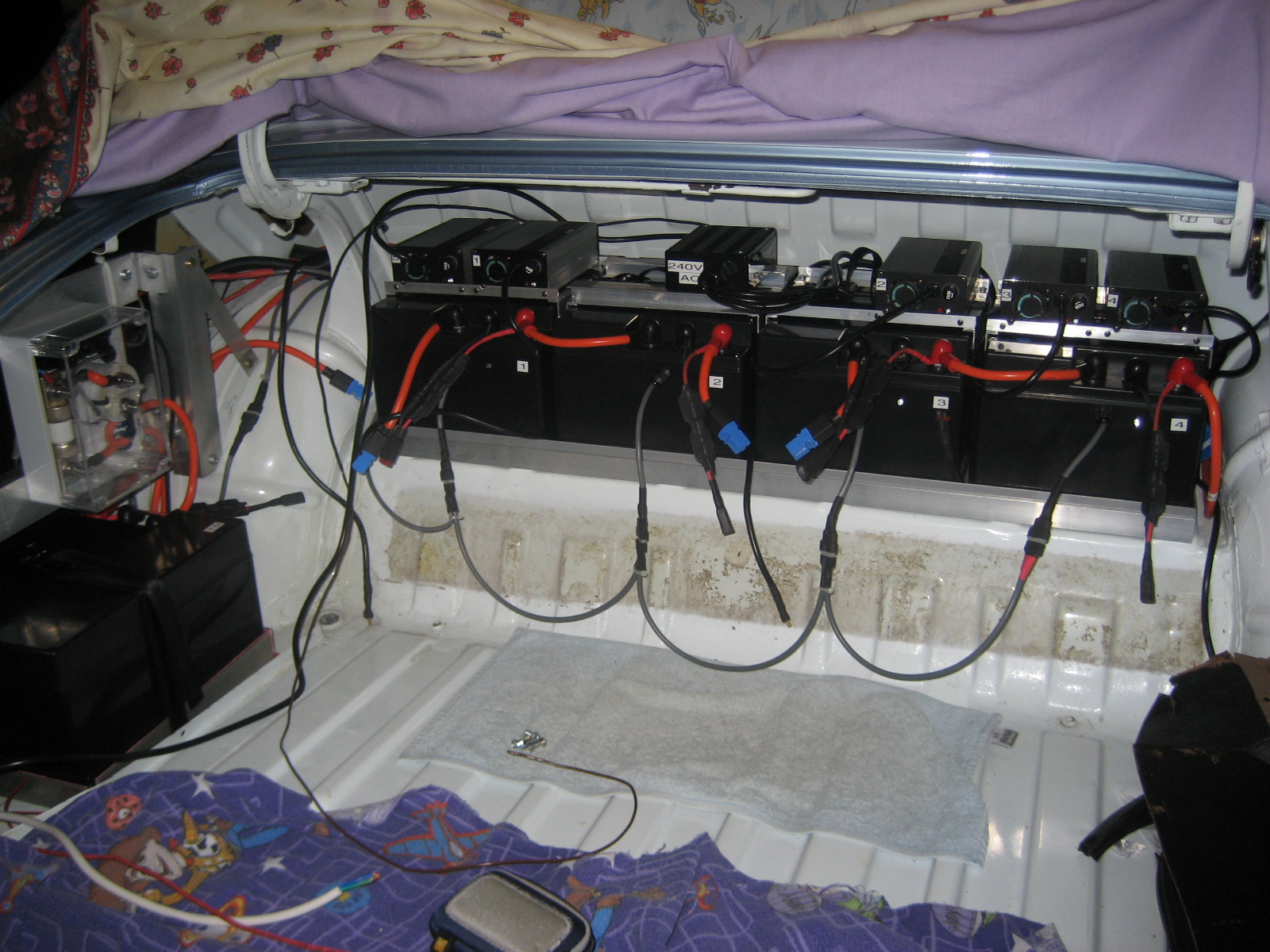
Simply placing the chargers in their mounting brackets on the rear battery packs didn't turn out so "simple". The 240VAC termination box was about 2mm too narrow so had to be partially disassembled and the holes filed. Then the straps for 3 out of 4 of the packs were in the wrong way around (it has to do with camlock buckle placement). Not wanting to remove all the packs then crawl under the car and unmount the main tray, I used the safety pin and nylon cord approach to carefully remove the strap while pulling the cord through - then pulled the strap through the other way.
Anyway - chargers in position.
Now to figure a way to route the wires so it looks reasonably tidy.

Wednesday, August 10, 2011

Rear Charger Mounting Progress

I originally intended the wires to the mains inputs on the chargers to be magically terminated somewhere at the back of the packs but a clean, neat system didn't work out. So I made one more pack-stradling mount (slightly different to the charger ones) and put a termination box on it (black box in the middle).
This is the order that they will be installed on the battery packs in the boot.
I managed to get an hour or so last night to finish the last mounting frame and wire up three of the chargers.
Just a few more wires and they can be strapped in.
This was the original sketchup. I see that a charger has moved from the left to the right of the middle mounting frame. The direction I installed the battery straps tends to dictate these things. The buckles take up room and the straps would be difficult to change. They are easier to tighten in one particular direction.
Actually that is why the two-charger frames are on the outside packs - it's so I can put the buckles down the sides of the packs.

Tuesday, August 9, 2011

Speedo Installed in Dash

I assembled the speedo into the dash a couple of weeks ago but forgot to put up a picture. The windscreen washer and heater control are stll not mounted but only because they are not convenient until the dash is ready to go in the car - and that's after the dashpad and windscreen.

Sunday, August 7, 2011

Rear Charger Mounting

With sore throat and head cold symptoms I braved the cold garage yesterday and cut up the aluminium for the rear charger mounts that I envisioned back in this post.
I started with three 1 metre long pieces of 20mm x 12mm x 1.6mm aluminium angle.
With suitable audience, the pieces are ready for assembly.
I built one first to check I hadn't made any weird mistakes. Here it is upside-down with 1.6mm neoprene rubber glued to the load- bearing surfaces.
Then into position with it. It is a great fit over the pack and is quite difficult to slide even without the strap. The strap will thread through easily, over the side section, between the chargers and the pack. A bit of a pain to get on though so I haven't done it until they are all ready.
Now to make another two of them.

Wednesday, August 3, 2011

Replaced RCD


I weakened. Much as I like to use as much recycled stuff in the Vogue as possible (provided it's reliable and safe), the 40 Amp RCD and 20 Amp Circuit breaker just take up too much room in the Mains box. I have ordered a 16 Amp combination RCD / MCB from eBay. Similar to this 10 Amp version. It'll give me  a lot more room to play with.

I hope it arrives for the weekend.

Tuesday, August 2, 2011

Mains Charger Power and Sequencer

With the Vogue now running it's about time the mains inlet was finalised so it can be charged easily.
This is a bit more complex than just connecting the 240 VAC mains plug to the chargers.
The reason is that I have 12 chargers. Each one is specified as drawing 30 Amps peak inrush current when switched on. It follows that all 12 would draw over 300 Amps inrush and I do not want to become unpopular when I want to pick up a get-me-home charge by blowing someones circuit breaker.

So - I have a system that switches on the first 4 chargers, then waits 2 seconds and brings up the next 3, then 2 seconds and the next 3 then 2 seconds and the last 2 chargers switch on.
I call it the Charger Sequencer.
The box, circuit breaker and RCD in this picture were "skunged" when the airconditioning system was changed at work. Since I have them, I'll include them. (The box already has a mounting place in the Vogue as you can see in a previous post that included pictures of the boot/trunk.)
The cable gland on the bottom is for mains inlet while the two white ones at the top are for front and rear chargers.
Here is a closer look at the Charger Sequencer PCB. The power supply is an 800 mA, 5 VDC phone charger. The relays came from a dismantled piece of test gear at work too (old ATE)!
It should be mounted and wired by the end of the week ready to go back into the car. You can see I have already cut up the piece of aluminium to mount the board.

For those who want to know how it works.

Friday, July 29, 2011

Better Quality Video of First Drive

SORRY - I'LL FIX THIS WHEN I FIND THE VIDEO AGAIN.

I have uploaded a better quality version of the Video to Youtube.

Sunday, July 24, 2011

First Drive - It's Not a Mixmaster!

The first time Laurel, my other half, saw and heard the motor running in the Vogue she indicated that she hoped I wasn't building a Mixmaster - a device that made whirring noises but didn't move. The Mixmaster joke has been ongoing in our family for almost a year now.

I put the Driveshaft in last night. We waited all morning for the rain showers to stop then just after lunch checked the weather radar map again and it showed clear for a couple of hours. The covers came off for the first time in about a year. I'm holding the keys.
The bonnet closed. Curously I was glad to see it still did!
Some quick video editing and...

Laurel says it's officially NOT a Mixmaster.
I should have put the dashboard in but I was really wanting to see it move. The fiddling with clip leads is to select forward/reverse. The ignition system and safeties were all operating.

Some stills.
About the only electric thing left to do is mount those rear chargers that you can see lying around in the boot.
There was an interesting moment halfway up the street where I stopped and some neighbours were in their driveway putting stuff in the boot of their car. The Vogue brakes gave a little squeak when it stopped and they looked up in time to see it silently take off in reverse - a priceless look. It's the next driveway up on the left from where the Vogue is in this shot.

Now for some lights, trim, glass, rubber, pinchweld, etc....

Some Fiddly bits

I hadn't expected to remove the controller tray quite so soon so had short-cut on a couple of items. The outputs of the DC-DC convertors were wired directly up to the 150A relay and since it had now become a "wiring loom" I needed to add some easy-to-unplug connectors. I also hadn't put a connector in the wire to the +300V contactor coil. I cut them both at a carefully considered point when removing the controller tray.

Here's a trick when soldering small connector pins. A handy vice made out of needle nose pliers and a rubber band. (Speaker connectors from SRM9000 radio.)


I use the same trick when holding connectors to be soldered. For the 20 Amp DC-DC wires I used a couple of XT60 connectors. These are another connector favoured by the serious RC Aeroplane guys/gals. I wish I had known about these before using the Deans connectors on the chargers.


Car side of connectors finished.
Ya gotta love heatshrink!


Once everything was refitted, the motor went fine with no battery warning alert when run. Strangely, the blue LED on battery pack #2 is faulty again. I'll get to that one night next week - maybe it's just coincidence. Now to fit the tailshaft.

Friday, July 22, 2011

Reversing solved and Battery warning identified

Shortly after the previous post and before removing the controller tray, I got reverse working. I had removed a 'function block' from the FB list in the controller knowing that my configuration didn't use it and the Lenze manual said they didn't - well they do! It was a block called ANEG which takes an analogue signal and makes it negative. The particular block was used to feed the low torque limit in the motor control block.
Anyway - now the motor runs either way - good.

The problem of the low-battery alert going off was not caused by the battery pack. The pack/BMS tested out fine using a couple of fan heaters as a load. I was able to duplicate the error by lifting a connection from one cell-pair to another momentarily and it got me to thinking. The motor cables go very close to the pack that was spitting the error.


Right at the point where the motor cables go next to the pack - on the inside of the pack - are the BMS wires - lots of them and running almost parallel to the motor cables.


So it's reasonable to assume that there is either capacitive or inductive coupling  at play here.
To help with capacitive coupling I did the following:


Take an offcut of brass fly wire and attach some heavy wires.


Cover the mesh with waterproof gaffer tape. What a mess - but I'll hide it under the trays so no-one will ever know. Well almost no-one....


And re-install the pack in the car, adding bullet connectors to the wires connected to the fly wire sheild and grounding them. Actually the pack from this location is now in the boot and this is a different pack (pack #5) - just to see if pack #10 really did have a fault that I missed.
To help avoid inductive coupling, the motor cable conduit is now tied well away from the pack.

A vew from another angle to show height separation, grounding wires - and the messy tape.
Now to stick the trays back in and try it...